How often do AI legal research tools hallucinate?
My team’s new study shows that AI legal research tools offered by LexisNexis and Thomson Reuters (Westlaw) hallucinate up to 34% of the time. I want to take a moment to explain why this matters.
The companies have claimed that these products provide “hallucination-free legal citations,” “avoid hallucinations,” and “dramatically reduce hallucinations to nearly zero.” We show that those claims are exaggerated.
When we released a preprint of the study last week, Thomson Reuters criticized it, saying we had evaluated a tool (Ask Practical Law AI) not intended for general legal research, and should instead have evaluated their other offering, Westlaw’s AI-Assisted Research. In fact, we had made multiple requests for access to AI-Assisted Research during our evaluation. The company refused until they saw the results of our study.
Our team has now completed our evaluation of AI-Assisted Research. Contrary to Thomson Reuters’s claims, the tool hallucinates nearly twice as often as the other legal AI tools we tested.
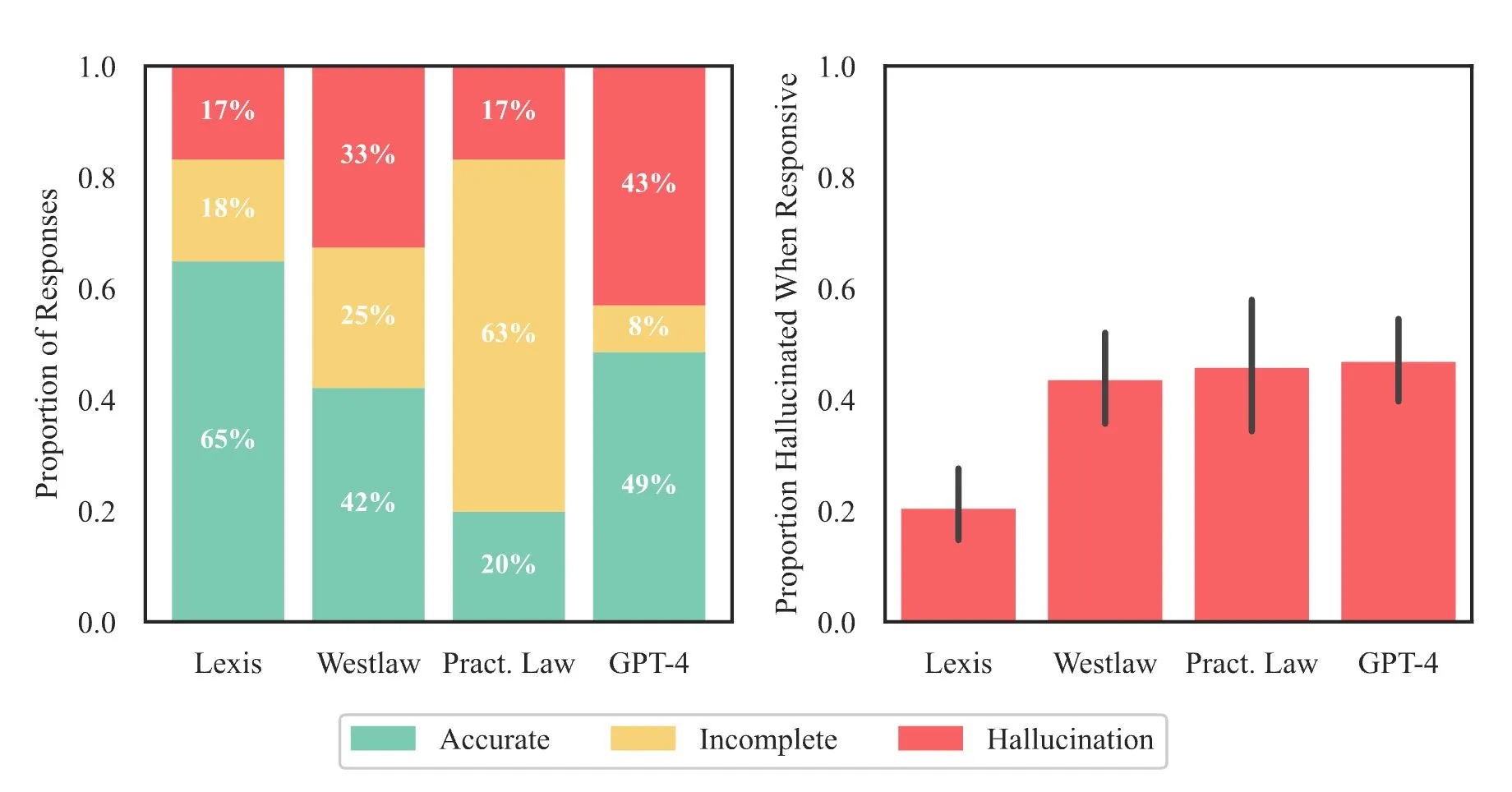
Left panel: overall percentages of accurate, incomplete, and hallucinated responses. Right panel: the percentage of answers that are hallucinated when a direct response is given. Westlaw AI-AR and Ask Practical Law AI respond to fewer queries than GPT-4, but the responses that they do produce are not significantly more trustworthy. Vertical bars denote 95% confidence intervals.
Our paper is not an exposé. We know that AI is not perfect. It is a call for transparency—for legal AI companies to back up their claims with empirical evidence, and to allow independent evaluations of their products. Our paper is the first to develop a rigorous methodology for evaluating the accuracy of legal AI products, and the first to describe their failure modes in detail. We hope that our work will be a useful guide to lawyers using these tools, researchers studying them, and the companies developing them.
You can read our blog post and the full paper.
Originally posted on LinkedIn.