Mapping racial covenants in Santa Clara County
The apartment where I live was once subject to a restriction: that it “shall never be occupied by any person not of the Caucasian race.”
Restrictions like these—racial covenants—are the subject of my team’s new paper. We show that by 1950, more than a quarter of all housing units in Santa Clara County were racially restricted. Many of these covenants explicitly banned Black and Asian residents or, as in the case of my apartment, allowed just white people.
Though they’ve been unenforceable since 1948, racial covenants remain on the books, and new homeowners still have to “agree” to comply when they purchase a once-restricted property. Last year, RegLab partnered with Santa Clara County to find and remove these covenants once and for all.
Over the past year, we built and trained a machine learning system to comb through more than 5 million pages of records for these provisions, and worked with the County to incorporate it into their legal process for redaction. We also map these covenants and show, for the first time, the true scale of housing discrimination in Palo Alto, San Jose, and all in between.
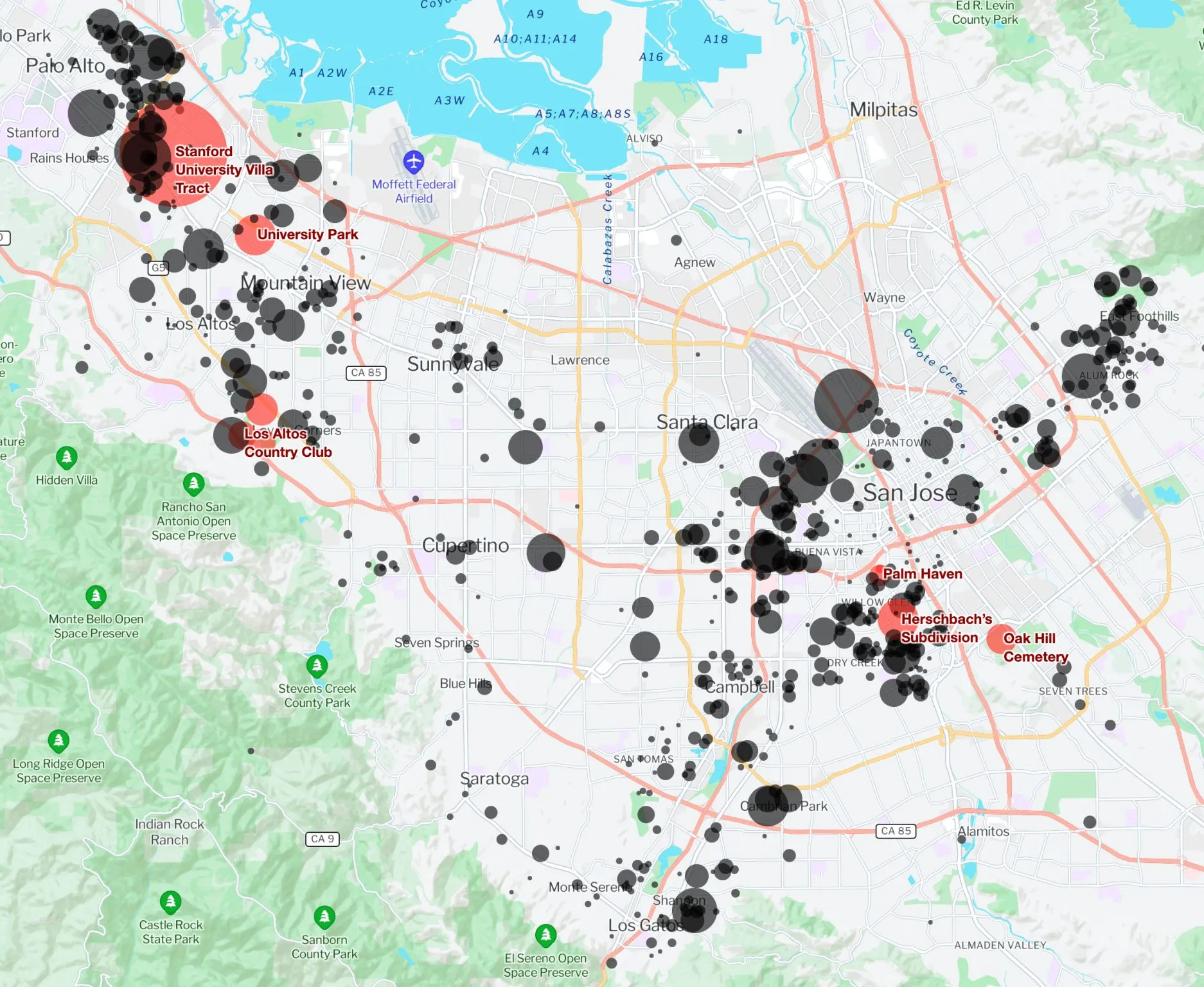
Racial covenants across Santa Clara County. Explore them on the interactive map.
We find entire towns racially restricted from their founding. Around Stanford University, more than a dozen developments prohibited non-white residents, “except as domestic servants.” Segregation was so pervasive it extended beyond the living: the Oak Hill Cemetery sold at least 50 burial plots for the sole use of “the Caucasian dead.”
Racial covenants, we show, were not a dark corner of our cities’ histories, but central to them.
And we think the implications of this work go far beyond the context of housing discrimination. As we see it, it’s a blueprint for a thousand more projects like it, capitalizing on recent advances in AI to reform outdated laws and legal documents at scale. To do empirical social science at a scale and granularity that would previously have been impossible.
This paper is the product of more than a year of work from a remarkable group of collaborators. I hope you’ll take the time to read it, and that you’ll get as much out of it as I have.
Originally posted on LinkedIn.